Showing posts with label scripture. Show all posts

Saturday, March 2, 2013

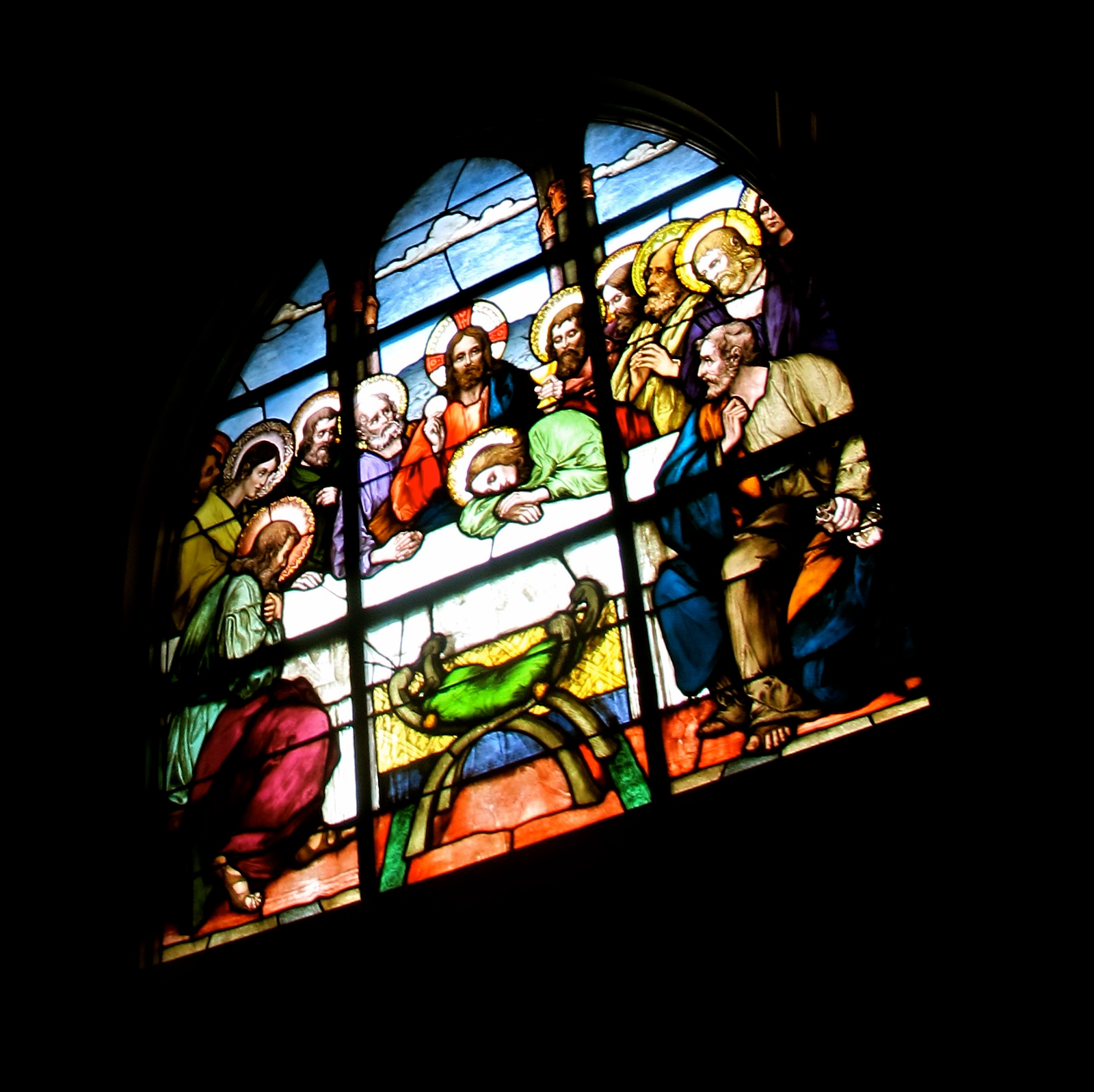
Sola Scriptura on the Road to Emmaus


by Ryan

St. Martin of Tours, St. Gregory Chapel, Louisville, Kentucky

There are times in life that a word or idea won’t go away — what composer Richard Wagner might have called a leitmotif. If something reoccurs enough times, and you are already a bit of an odd ball, you begin to think: Surely, this is a sign. My sign? Emmaus.
  • A church's outdoor sign on the drive to my school, featuring the Emmaus Road Quartet. This Sunday only!
  • A fellow teacher asking me if I was attending an Emmaus Walk this year.
  • My latest Bible study taking me to Luke 24, where a passage about the road to Emmaus is found.
Well, Emmaus it is! I try my hardest to read each chapter in my Bible study as if I were reading it for the first time. My most recent study of Luke 24 unearthed something rather unexpected — a harrowing challenge to sola scriptura — the idea that any Christian can understand, without error, the things of God with the Bible and the inspiration of the Holy Spirit. It is not my goal, however, to refute sola scriptura point by point (there is already abundant material available to that end), but rather to reflect on this reading and the aforementioned challenge it would seem to give the subscriber to that theological viewpoint.

St. Louis Bertrand, Louisville, Kentucky

The account of the road to Emmaus can be found at Luke 24:13-35. Two travelers (one who is named Cleopas) are returning to Emmaus from Jerusalem and are recounting amongst themselves the events of the last few days — involving Jesus, his death and seeming disappearance from the tomb. During their conversation, Jesus joins them on the road; the eyes of the disciples are obscured from recognizing their Savior. The next few lines of the story struck me as peculiar:
“Then he said to them, Too slow of wit, too dull of heart, to believe all those sayings of the prophets! Was it not to be expected that the Christ should undergo these sufferings, and enter so into his glory? Then, going back to Moses and the whole line of the prophets, he began to interpret the words used of himself by all the scriptures.” (Luke 24:25-27)
For the subscriber to sola scriptura, the following text must come as a shock — the disciples do not yet realize that Jesus is in their midst — they have not been brought to all understanding by hearing the scriptures. Even though their hearts “did burn at his words” (Luke 24:32), the glory of God remained concealed. An objection might be made on the grounds that the travelers did not yet have the Holy Spirit; indeed, that the Spirit did not yet have them. This objection would seem to be nullified when considering that it is God-Made Man, Jesus Christ, who was teaching the travelers, and even the Word of God from the Word-Made Flesh does not open the eyes of Cleopas and his companion. It is in the next turn of events where these disciples finally see:
"And then, when he sat down at table with them, he took bread, and blessed, and broke it, and offered it to them; whereupon their eyes were opened, and they recognized him; and with that, he disappeared from their sight."(Luke 24:30-31)
This, to me, has to be the difficulty of difficulties in this passage: Jesus reveals himself through the appearance of bread. Not only that, but he uses a prayer formula very similar to that found in Luke 22:19. This Passover prayer is where he equates the bread with his body: "This is my body." Here, a handful of hours after his resurrection, Jesus seems to show us that his Passover sacrifice is in continuance — not as a repeated sacrifice, but the same sacrifice in perpetuity. It is in this re-presentation of the Passover meal that Cleopas and his companion meet Jesus; they come into contact with Christ in the flesh — not merely a symbol. What the scriptures anticipated, in mysterious and clouded ways, as “through a glass darkly” is now seen “face to face” (1 Corinthians 13:12) — the physical reality of Christ, revealed in simple bread. If the travelers met Jesus in this bread, then is it such a stretch to think that we, weary travelers on the road to life, still meet Jesus in this way?

St. Louis Bertrand, Louisville, Kentucky

So, are the scriptures then unimportant next to the glory of God manifested in this bread? I think that would create a false dichotomy — these things do not oppose each other, since they are both of Jesus Christ, who is the Word of God (the scriptures) and the Word-Made Flesh. The incident on the road to Emmaus shows us that these realities reside together, belong with each other, reveal each other. Indeed, it is these two ideas that we find bound together in the Mass. Or, as found in scripture under the appearance of marriage: “…what God, then, has joined, let not man put asunder" (Matthew 19:6).

Sunday, December 30, 2012

What I Wore Sunday

by Shannon


"So may the peace of Christ, the very condition of your calling as members of a single body, reign in your hearts. Learn, too, to be grateful."
– Colossians 3:15

Merry Christmas and happy Feast of the Holy Family! Unfortunately, I attended Mass alone this morning. Since Boxing Day, the three of us have been rotating a 24-hour stomach bug, and yesterday was Cruncher's turn. We decided Ryan would stay home with the little guy while I went to Mass this morning. I love going to Mass alone but would have preferred it be under different circumstances. Father had a lovely message today, and here's a snippet: The family is so important that God saw fit to entrust one with His only Son. Pray to recognize the important role parents have in their children's lives, and don't sell yourself short. 

Today, I dressed comfortably. I was rushed this morning, following an exhausting night holding a bucket under a sick boy's chin. BTW, his appetite is back today, so maybe we'll all be healthy again for a few weeks.


Deets:
Earrings: Target
Sweater: Old Navy
Jacket: Meijer
Watch: Fossil
Skirt: LOFT
Tights: TJ Maxx?
Boots: Sears


I rolled up the sweater's sleeves under the jacket. It looked sloppy with them sticking out. The jacket was a great clearance find on Christmas Eve. It's actually part of a two-piece set, which I will never wear at the same time. I would feel too much like my mother (no offense, Mama!). The skirt is ankle-length, of the same pattern, and I wore it to Midnight Mass with a belted purple sweater and the same boots. P.S. Time to get my ears lowered. Looking poofy.


Mmm ... sweater tights. And super-old boots I bought to wear with my interview suit eons ago.


Two unusual things about this outfit for me: No necklace, and no vintage items. If it weren't for this pleather-lined, gold zipper, I wouldn't have bought this jacket. I liked the contrast between the soft, watercolor fabric and the edgy zipper. Brooches and necklaces would compete too much with the fabric and zipper, so I just stuck with earrings and my usual watch.


Bee or beetle? I think the stripes throw off people, but there's no stinger. They more remind me of the gold scarab beetle that opens the Cave of Wonders in Aladdin (yeah, I had to Google that). Which then makes me think of the scarabs in The Mummy. *Shivers.* Glad I don't have to look at them when they're on my ears. Nightmares. Anyway, I thought bug earrings would look cute with the flowered jacket. 

No lecture this week. Class is adjourned. Oh, and your homework: Visit the other ladies over at Fine Linen and Purple for more femininity and fashion. And a few dudes too. 


Monday, June 18, 2012

Of Saints, Skeletons and Saison (Part 2)

by Ryan


"A faithful friend is a sturdy shelter; 
he who finds one finds a treasure."
– Sirach 6:14


With all of this talk about saints from centuries long gone, one could be forgiven for thinking that the Catholic Church puts too much focus on these outstanding individuals. However, as my friend Marie points out, the Church is often a “both/and” institution. As in, we focus on saints of the past and of the present. While the saints of the past no longer need our aid in reaching their heavenly reward, the saints of the present need all the help they can get.


Without getting into a long discussion about the sacraments of the Church and their role in maintaining the saints of the present, one might wonder how a saint can be recognized. The book of Galatians offers this handy checklist:

“...the fruit of the Spirit is love, joy, peace, patience, kindness, generosity, faithfulness, gentleness, self-control. Against such there is no law.” – Galatians 5:22-23
Reading that list of wonderful qualities makes me shudder! I feel that I fall horribly short of those aspirations most of the time. That’s why I find immense value in friends like John. I met John and his wife Drina in our parish choir, and we visit each other when we have the opportunity. 

After listening to the ninety-minute presentation on SS. Magnus and Bonosa, John and I went over to Sergio’s World Beers, a beer lover’s paradise located a short distance from the popular Frankfort Ave. area. I love visiting Sergio’s because it has such a wonderful beer selection, but is also usually quiet enough to have conversations and relax. 


John, though not a beer enthusiast at heart (he prefers bourbon, I believe) seems to always have an open ear as I endlessly rattle off beer stories, facts, style, etc. One of our most recent conversations involved saison, a beer style originally consumed by Belgium’s seasonal farmers. These beers range from a pale gold to amber in color (usually the former), though darker examples can be found; Jolly Pumpkin’s Bam Noire, for instance, pours a deep, rich brown.


Fantome's Dark White saison with stoneware vessels 

The saison we shared was from the small Fantome brewery in Soy, Belgium, and also represents a departure from typical saison with its darker amber color. This saison, called Dark White, struck with a damp, musty, herbal aroma with some notes of red grape and apple. The initial pouring of this beer filled our glasses with a huge, billowy head that never really went away. The flavor was quite similar to the aroma — lots of damp, musty character, but the fruit shined through a bit more, making the overall flavor much more refreshing than the initial aroma; the finish was dry and lingering. Dark White, in the manner of other great Belgian beers, had an effervescent mouth feel that seems to dissolve on the palate.

Before my rather extended passage on beer, I was talking about John and Drina, and their “immense value.” The Catholic Church actually considers the saints — past and present — as part of the “Church Treasury.” We usually associate the word "treasury" with money, but the end goal of the Church is for those who were born of God to return to Him; to this end, the value of the saints on earth as extensions of God’s virtues cannot be measured. I consider John, Drina, and many other friends and family as part of this treasury. I hope you find yourself just as fortunate.

John (hopefully) enjoying his glass of Dark White.


Friday, June 15, 2012

In the Beginning...

by Ryan

“We seem to have our best conversations in the car.”
– Me (Ryan)


When I decided to leave Facebook about a month ago, I knew right away I would face a challenge in keeping people in my life up to date with things at our household. This blog — The Sword and the Stein — is Shannon and my solution. This may seem like a peculiar family blog name, but I find the meaning behind this title very appropriate for our lives, as well as the lives of Christians around the world. (More on that in a bit.)

A typically cliché statement when naming a blog might be: “Naming a blog is like naming a baby!” Well, in a way, I think it’s more difficult. That is, unless you are like Frank Zappa, and your children have completely zany names, such as Dweezil and Moon Unit. Anywho, needless to say, we had a hard time naming the blog and went through several ideas before coming to
The Sword and the Stein.

One of the more interesting ideas we had stemmed from a visit to St. Charles Borromeo parish in Milan (pronounced: My-len), Indiana. This parish has always felt like home to me. We were attending the 8 a.m. Mass when we heard an announcement that went something like this:

“If you left your rosary at the Resurrection … I mean, The Reservation … (various laughter from the parishioners), it is available for pickup in the Parish Hall.” (The Reservation, by the way, is a restaurant in Milan with cheap Native American-ish décor and a tasty breakfast menu.)

Because of this hilarious instance, Shannon and I long contemplated playing with “If you lost your rosary at the Resurrection…” as a blog name, among others. Shannon and I usually discussed the rationale behind these choices on various car rides, bedtime conversations and other stolen moments.

Hey, girl. Nice mug.

So, I’m guessing you really just want me to tell why we named our blog after a weapon and a drinking vessel. The sword represents the word of God; in Ephesians 6:17, the word of God is “a sword of the spirit.” Hebrews 4:12 calls the word of God “sharper than any two edged sword … and able to discern reflections and thoughts of the heart.” So, while we may wish from time to time to scrutinize the behaviors of our fellow man, we will also look for opportunities to scrutinize our own hearts, since “a good heart is a continual feast” (Proverbs 15:15).

Awkward Family Photos, anyone?

The stein, the well-known drinking vessel of Germanic peoples (and the German word for “stone”), represents the world and all of its pleasures. We all have some pastime, hobby, diversion, etc. that adds dimensions to our lives and perhaps contributes in some way to our uniqueness as individuals.

Some of our blog posts may be more of the “sword” variety, with other posts addressing more “stein”-worthy topics. And then some may be a mixture of the two. I think this is the essence of the devout life, which we try to live with God’s aid. 

Either way, we hope you enjoy our blog.